
Seeking Stillness in the Age of AI
How ancient practices restore balance and peace in a world spinning at light speed.

There is a unique kind of vertigo that comes with being a Millennial in tech.
Being a Millennial, I am often awestruck by the sheer distance my generation has traversed. We are the bridge generation—the last group of humans who will ever remember the quiet, analog texture of a world before the internet, and the first to build a hyper-connected, digital reality.
We began with the dial-up tones and Easter egg hunts of the early web, transitioned through the era of desktop towers, laptops, and pocket-sized smartphones, and now stand amidst an artificial intelligence revolution where ideas turn into shipped reality in minutes. Living through this transformation makes a single human lifetime feel as vast, deep, and storied as a millennium.
Caught on the tectonic seam between two eras, we are constantly trying to find our balance on an accelerating earth.
Yet the faster the external world accelerates, the louder an ancient question becomes:
"How do we live in this world, but not of it?"
For me, the answer didn’t come from a faster processor or a cleaner line of code.
It arrived on a yoga mat and a meditation cushion.
The Natural Stillness of the Early Web
When I look back at the infancy of the internet, I don’t just remember the clunky hardware; I remember the pacing. In those early days, technology came with built-in boundaries.
We treated the web with a slow, deliberate curiosity that feels almost sacred in hindsight. Finding a personal webpage or an obscure forum felt like stumbling onto a hidden courtyard. Crucially, the early internet had an exit door. You logged on, you explored, and then you logged off.
Stillness was protected by the very limitations of the machine.
The Disappearance of the Gaps
As our devices shrank—moving from stationary desks to our laps, and eventually collapsing into the palms of our hands—the friction disappeared. And with it, the quiet gaps of our lives vanished too.
The boundary between "online" and "offline" dissolved entirely. The internet ceased to be a place we visited and became the invisible atmosphere we lived in. The interstitial moments that used to be naturally vacant—standing in line, riding an elevator, resting on a quiet evening, or simply sharing a meal with our friends and family—were immediately colonized by notifications, algorithmic feeds, and the ambient hum of an infinite web.
The AI Frontier
Now, as intelligence itself becomes automated, the cycle spins faster than ever before. Creation is instantaneous. Optimization is relentless.
Witnessing this transformation is an extraordinary privilege, but it carries an invisible psychological weight. Our generation has navigated multiple civilizational shifts before even reaching mid-career, and our nervous systems were never wired for this kind of excitement and velocity.
The Sacred Pause
When the external world demands continuous processing, the mind becomes perpetually overclocked. This is where yoga and meditation ceased to be casual wellness habits and became a radical act of restoration.
On the mat, the feedback loop is entirely analog: the weight of feet on the floor, the release of tension in tight shoulders, and the slow, smooth flow of breath. There is no urge to produce, optimize, or be somewhere else. The mental chatter drops away, leaving room to truly listen—to the body, the breath, and the spirit within.
Meditation is not an escape from reality; it is a homecoming to what is real. It does not ask you to solve, produce, or optimize—it simply invites you to rest as the spacious awareness behind the noise of your own mind.
Together, the movement and the silence dismantle the frantic speed of the modern world, returning us to the only place peace has ever lived:
The unhurried, unchanging present.
Cultivate Stillness in Your Inbox
Enjoyed this article? Join our community for mindful practices, asana tips, and inner reflections delivered directly to your inbox.
The Gift of Teaching Yoga
As a yoga teacher, I am deeply grateful to share the love of yoga with others.
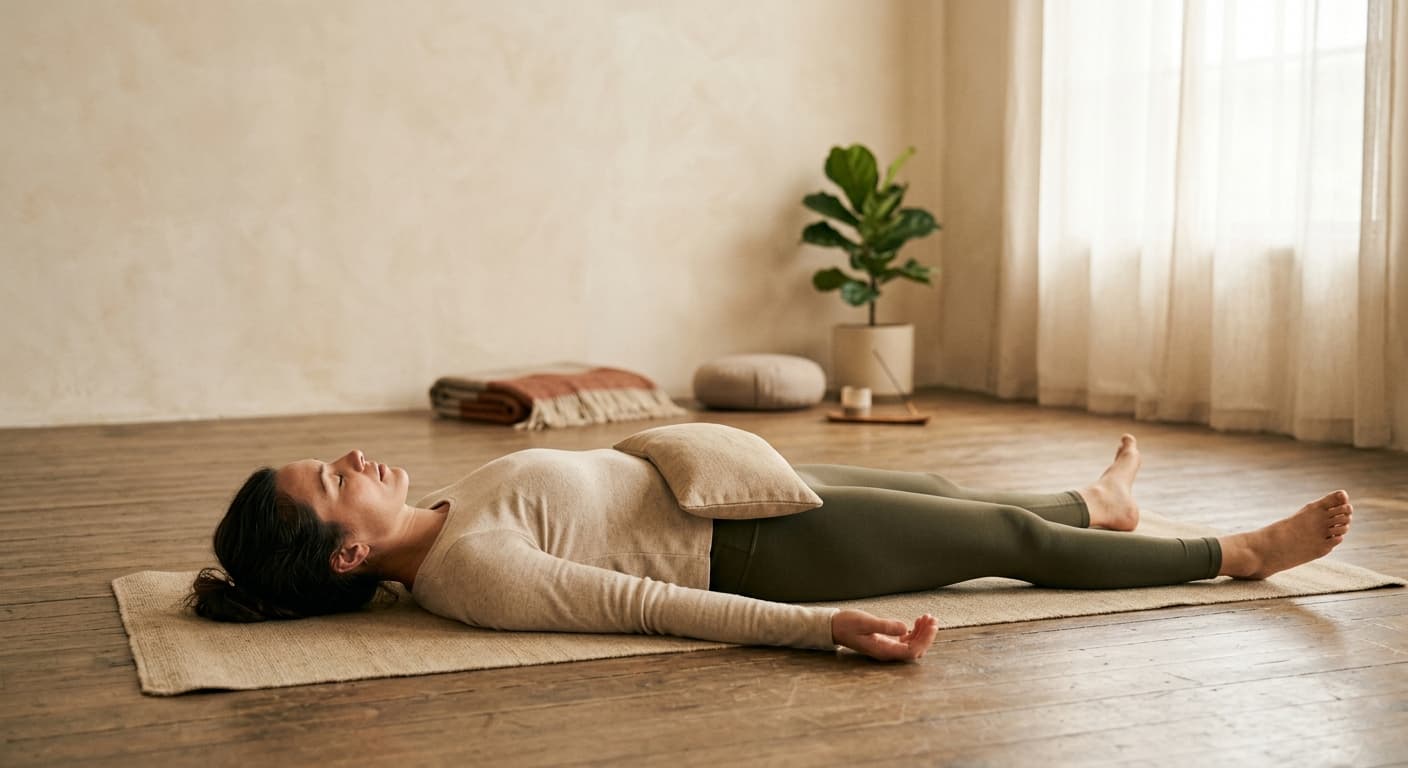
Sandbag Breathing
Cultivate Healthy Breathing Through Gentle Resistance: Reconnecting with the natural movement of the diaphragm.
Welcome to Flow Into Stillness: A Sanctuary for Mindful Living
Discover our mission to bring peace, alignment, and mindfulness into daily life through yoga flows, breathwork, and reflective practice.