
Sandbag Breathing
Cultivate Healthy Breathing Through Gentle Resistance: Reconnecting with the natural movement of the diaphragm.
In the rush of day-to-day life, many of us carry a subtle restlessness in the body. Stress can shorten the breath, tighten the ribs, and pull our attention away from the present moment.
A simple sandbag-breathing practice can help us reconnect with the natural movement of the diaphragm, build awareness of our breathing patterns, and cultivate a steadier relationship with effort and ease.
This is not about forcing a bigger breath. It is an invitation to become curious about the breath you already have—and to trust that the body knows how to respond.
Meeting the Diaphragm
The diaphragm is a dome-shaped muscle located beneath the lower ribs. It is one of the primary muscles involved in breathing.
As you inhale, the diaphragm contracts and moves downward, making space for the lungs to expand. As you exhale, it relaxes and returns upward. You can feel its effects through the expansion and softening of the lower ribs and belly.
Begin With Curiosity
Before changing anything, take a moment to simply feel your natural breath.
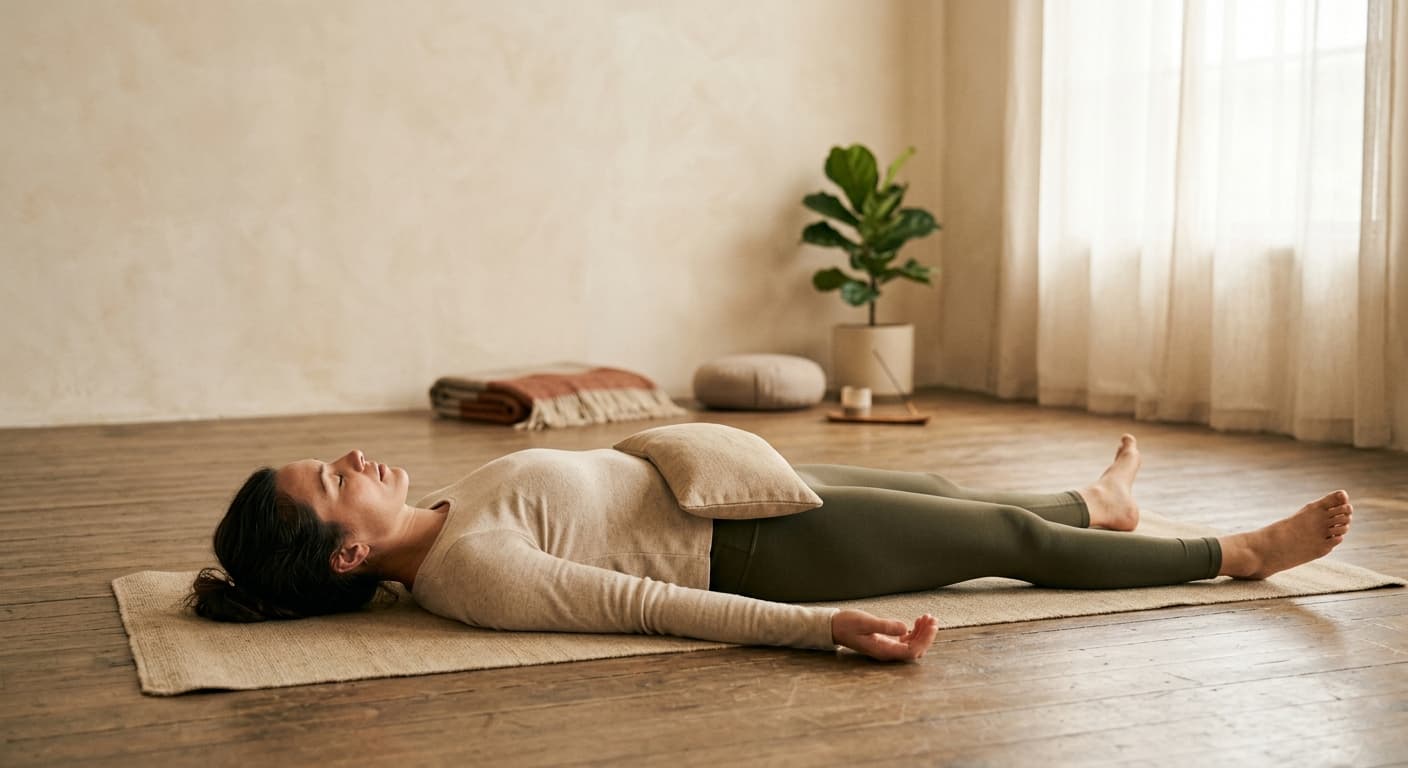
Lie down comfortably in Savasana—on your back, with your legs supported or extended and your arms resting by your sides. Let your face, jaw, shoulders, and belly soften.
For a few moments, observe:
- Does the inhale feel longer than the exhale, or is the exhale longer?
- Are there natural pauses between breaths?
- Does the breath feel smooth and consistent, or uneven?
- Is the breath quiet, audible, shallow, broad, fast, or slow?
- Where do you feel the breath most clearly: the chest, side ribs, belly, back body, or throat?
There is nothing to fix here. Let this be an act of listening rather than evaluating.
The Sandbag Practice
For this practice, use a yoga sandbag of approximately 10 pounds. If that feels like too much, begin with a lighter sandbag, a folded blanket, or a small weighted object that feels safe and comfortable for your body.
While you are in Savasana, place both hands around the bottom of your rib cage. Feel for the gentle outward movement of the ribs on the inhale and their soft return on the exhale.
Stay here for several breaths. Let your hands receive information from the body.
Then place the sandbag gently horizontally across the upper abdomen and lower rib area—where you felt the movement of the diaphragm. It should rest comfortably, not press sharply into the ribs, chest, or throat.
Take a moment to notice the sensation of weight.
You may feel slightly restricted, challenged, or uneasy at first. That is natural. Rather than resisting the sensation or trying to overpower it with a large breath, stay with what is present.
Let the weight become an object of awareness.
Breathing With Gentle Resistance
Continue breathing naturally beneath the sandbag.
Notice how the breath responds to the gentle resistance. You may find that the inhale becomes more deliberate, while the exhale becomes quieter and more complete. You may also notice the lower ribs expanding into the sides and back body.
Allow the inhale and exhale to become balanced—not necessarily identical in length, but smooth enough that one breath follows the next without strain.
Let each inhale arrive without grabbing. Let each exhale release without pushing. Simply feel the completeness of each breath.
Stay for a few minutes, perhaps two to five minutes, depending on your comfort and experience. The practice should feel steady and manageable, never painful, panicky, or breathless.
Let Go of Control
Breathing practices can easily become another place where we try to perform, improve, or control.
Instead, let this practice be a reminder to release the grip.
Notice what you notice without judgment. Feel the body working gently beneath the weight. Feel the intelligence of the breath adapting moment by moment.
You do not need to make anything happen.
Trust that the body will provide the breath it needs.
Stay with the natural rhythm for another couple of minutes, allowing the breath to flow freely and effortlessly beneath the sandbag.
Feel the Spaciousness
When you are ready, slowly remove the sandbag.
Pause before moving. Notice the breath without the added weight.
Many people experience a sense of spaciousness through the diaphragm, lower ribs, or belly after the sandbag is removed. The breath may feel lighter, wider, more accessible, or simply easier to observe.
Remain lying down for several breaths. Then slowly roll to one side and take your time coming up to a comfortable seated position.
Sit quietly for a minute.
Feel the breath moving through you now.
A Practice of Returning
Sandbag breathing is not only a physical practice for the diaphragm. It can also be a practice of meeting resistance with steadiness.
Life offers plenty of moments that feel heavy: deadlines, uncertainty, loss, change, conflict, and the endless movement of a busy mind. We may not always be able to remove the weight immediately. But we can learn to soften around it, stay present, and breathe without abandoning ourselves.
Our yoga practice is both a means and an end: a way of reconnecting with our true nature.
When we are grounded in that deeper place—steady, aware, and connected—we can meet what life offers with a little more ease, gratitude, and love.
Cultivate Stillness in Your Inbox
Enjoyed this article? Join our community for mindful practices, asana tips, and inner reflections delivered directly to your inbox.

Seeking Stillness in the Age of AI
How ancient practices restore balance and peace in a world spinning at light speed.

The Gift of Teaching Yoga
As a yoga teacher, I am deeply grateful to share the love of yoga with others.

Welcome to Flow Into Stillness: A Sanctuary for Mindful Living
Discover our mission to bring peace, alignment, and mindfulness into daily life through yoga flows, breathwork, and reflective practice.